Sovereign Connection & Consent
A community field guide to sovereign connection, conscious boundaries, and living in better relationship with ourselves and others.
This field guide to Sovereign Connection and Consent is designed to help us experience more sanctity and connection in our world. It translates the deep energetics of consent from abstract ideals into pragmatic, daily actions you can use right now, whether you are navigating a boardroom, managing a shared household, or simply connecting with a stranger.
Use this guide as a dynamic toolkit, not a rigid rulebook. Consent is a living, breathing dialogue. Take what resonates, experiment with the applications, and actively build the community you want to live in, every single day.
The lists and scenarios provided are by no means exhaustive nor prescriptive. Adapt to suit and come up with your own, discovering your unique way of asserting your magnificent sovereignty.

Before deep connection, creative collaboration, or learning can occur, we must establish an intentional, explicit, and safe psychological and physical container.
Setting the container means defining the rules of engagement before diving into interactions, meetings, workshops, or social gatherings. Containers exist on multiple levels:
- Macro-Containers: Environments such as public workspaces, entire homes, festival play spaces, or broader community spaces.
- Micro-Containers: The intimate sub-structures within those spaces, such as a specific project workgroup, a family unit, a co-habitation dynamic, or a tight-knit friend group.
Regardless of size, the foundation of every container must be built on mutual respect and consideration. It replaces default-world ambiguity and anxiety with explicit expectations and felt safety.
Set Your Personal Intake Container: Before entering a high-energy space, pause and check in with your capacity: "How many spoons* do I have for social interaction right now?"
* unit of combined mental & physical energy capacity
Micro-Container Grounding: Before entering group settings, define your exit strategy and personal check-in intervals so you retain agency should things become overwhelming.
Active Bystander Setup: If you notice a gathering where the container feels chaotic or unsafe, step in to clarify parameters: "Hey everyone, let's pause for a second and check if everyone is on the same page with how we're running this."
Explicit Scope Setting: Some group dynamics may require actively stating what the space is not for (e.g., "We are here to brainstorm logistics today, not to evaluate personal choices"), proactively protecting everyone's boundaries.
Opening a workshop/meeting: "Welcome everyone. Before we begin, remember that everything shared here is confidential. You have the full right to pass on any activity, and if you need to step out for any reason, please do so respectfully."
Setting a micro-container at home/work: "I'd love to talk this through with you, but I only have 10 minutes before my next commitment. Can we keep our focus strictly on the scheduling details for now?"
- Establish Rules of Engagement: Openly discuss how a group will operate, centring respect and consideration as non-negotiable baselines. At the start of any new meeting or gathering, explicitly state confidentiality expectations, the right to pass on exercises, and self-care options.
- Dismantle Inherent Hierarchies: Acknowledge power dynamics in the room so participants know their agency is equal and their "no" will be honoured without penalty.
- Read Somatic Cues: Pay attention to non-verbal signs of discomfort or trauma responses – including fight (irritability/defensiveness), flight (restlessness/seeking exits), freeze (numbness/paralysis), fawn (over-pleasing/appeasing), and flop/faint (disassociation or extreme lethargy) – rather than relying solely on surface-level verbal agreement. Allow people the time to check in with their internal emotional compass. Give them permission to give deeper, honest responses instead of demanding quick ones.
- Set Clear Parameters: Define the scope, duration, and boundaries of an interaction before it begins (e.g., "We have 15 minutes to discuss this logistical issue, and then we will pause"). Assist with mini-containers for individuals who aren't able or are unaccustomed to having their boundaries respected.
You cannot cultivate true consent in an environment where people feel unsafe, rushed, or judged. Setting up safe containers transform a space from survival compliance into genuine relational freedom. In already-compromised spaces, creating a sturdy micro-container (a safe sub-group) can act as a primary protection against broader toxic cultures.
Consent is an energetic, living practice rooted in personal sovereignty and mutual agency, far exceeding mere legalistic checklists.
Mainstream media often portrays consent as a legalistic buzzkill, while romanticising boundary crossing, persistent "chasing", and coercive escalation. Sovereign Connection shifts the paradigm: your body and emotions are your primary compass, and true consent is the voluntary, informed, and enthusiastic agreement to grant access to your personal space.
This guide encourages learning to navigate this dance of who we voluntarily allow into our personal space and to what degree, combined with how we interact with those who voluntarily allow us into their personal spaces and to what degree. While we are learning to uphold our boundaries better and progressively prevent them from being crossed, together with handling other people's boundaries with grace and emotional maturity, we are also learning to create spaces and communities who honour and respect each other's personal boundaries as a given rather than an after-thought.
Decouple Guilt from Boundaries: Remind yourself that saying "no" to a request is an act of honesty, not an act of hostility.
Sovereign Non-Explanation: Practise giving a clean "no" without adding elaborate excuses or justifications, honouring your right to state a boundary without needing to validate it.
Check for Pressure: If someone agrees very quickly to an offered gift or favour, explicitly release them from any obligation: "Just to be clear, that favour was a gift. You don't owe me/them anything."
De-escalating Reciprocity Pressure: When offering space or assistance, explicitly remind the recipient that they may decline or leave at any time without offending you.
Decoupling obligation: "Thank you so much for helping me move my furniture yesterday! I really appreciate it. However, I don't have the capacity for a dinner date tonight, but I hope you have a wonderful evening."
Sovereign Non-Explanation: "Thank you for the invitation to join the weekend trip. It sounds wonderful, but I won't be able to make it. Have a fantastic trip."
- Reframe Consent as Access: Recognise that giving consent grants a limited, revocable pass into your personal boundaries; it is a privilege, never an entitlement.
- Decouple Appreciation from Obligation: Differentiate relational connection from transactional debt. Never agree to physical, emotional, or logistical access simply because someone bought you a gift or otherwise did you a favour. By all means, show appreciation through gifts of objects and favours. However, you cannot unfairly assume that any gift demands reciprocation. Any kind of reciprocation needs to be established clearly upfront and agreed by all parties concerned.
- Prioritise the Nervous System: Understand that genuine consent cannot exist when your nervous system is in a state of fear, threat, or survival compliance. Step away from the situation or request time to consider your options. If you are the one putting pressure on anyone else, ease off and give them the time and space to securely consider their options.
- Embrace Ongoing Agreement: Treat consent as a living dialogue that can be adapted, paused, or revoked at any moment. As the person requesting access, be attentive of when granted access expands and when it contracts. As the person giving access, be attentive of when you are over extending and when you could perhaps loosen up (if the situation isn't definitively safe, default to being more cautious). The more clear each person is about what level of access they desire and are comfortable with, and can share this information with each other, the cleaner the interaction.
When you view consent as an act of self-respect rather than a set of external restrictions, setting boundaries becomes an empowering expression of love for yourself and others.
Your somatic and emotional states are your ultimate inner guidance system.
Conditioning often teaches us to override our bodily impulses in favour of politeness or external validation. Learning the "Energetics of You" means recognising default nervous system reactions, both in the moment and upon post-interaction reflection.
- Fear-Based Freeze/Fawn: A survival compliance mechanism where you agree to a request out of fear, a desire to appease authority, or to avoid conflict.
- Awe-Based Freeze/Fawn: Being "star-struck" or overwhelmed by deep admiration, joy, or sudden attraction. While positive, it still overwhelms the nervous system, rendering a person temporarily unable to make grounded, fully informed decisions.
Notice how a "yes" or "no" physically feels inside your body. Combine this data with your mind's rationalisations to determine whether you are in a position to make a decision or need time to consider. Reject surface-level default responses that may be unhealthy for either party.
If you realise mid-interaction that you have entered a freeze (numbness/paralysis) or fawn (over-pleasing/appeasing) state:
- The Physical Anchor: Press your feet firmly into the ground or curl your toes inside your shoes to bring awareness back to your extremities.
- The Exhale Shift: Take a slow, deep breath in, and extend your exhale longer than your inhale to signal safety to your nervous system.
- The Pause Button: Interrupt the momentum using simple, neutral language to buy time to regulate.
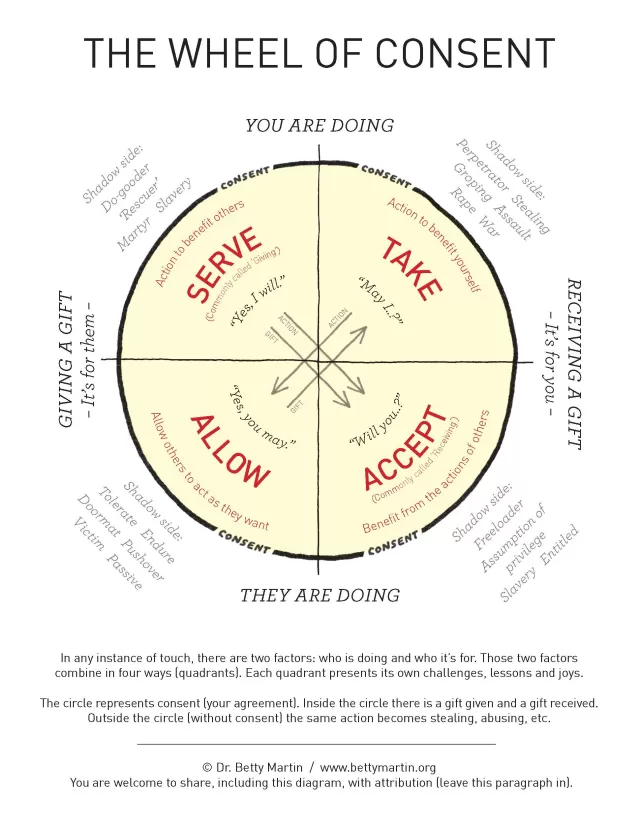
To truly understand your somatic responses, you must learn to separate two distinct questions in every interaction: Who is doing the physical action? and Who is the action actually for?
Dr Betty Martin's Wheel of Consent framework helps clarify who receives the benefit or pleasure of an interaction which, in turn, helps remove hidden coercion, guilt, and obligation
When these dynamics are confused, we can fall into default-world traps by enduring a touch or conversation we don't want because we are "polite", or we give from a place of exhaustion rather than genuine joy. Tuning into your energetics means asking yourself in real time: "Am I doing this because I genuinely want to, or am I just allowing it out of obligation?" When you know who the action is for, you can make clearer, un-coerced agreements, ensuring that every "yes" is grounded in authentic desire rather than quiet compliance.
- The Physical Anchor: Press your feet firmly into the ground or curl your toes inside your shoes to bring awareness back to your extremities.
- The Exhale Shift: Take a slow, deep breath in, and extend your exhale longer than your inhale to signal safety to your nervous system.
- The Pause Button: Interrupt the momentum using simple, neutral language to buy time to regulate.
Practise the "3-Second Pause": When asked for a commitment or physical access, take three seconds before speaking to check your gut baseline.
Look for Somatic Contraction: If a person says "yes" verbally but their shoulders slump, their eyes dart, or their breath shallows, do not proceed. Pause and offer an easy exit.
Buying time during a Freeze/Fawn response: "I need a moment to process my thoughts. I'm going to step away for 5 minutes and get some air before I answer that."
Offering an exit to an uncomfortable person: "I noticed you hesitated for a moment. Please know that 'no' is completely fine with me! Do you need a minute?"
- Identify the "Hell Yes": Notice physical markers of enthusiastic consent, such as a feeling of expansion, warmth, lightness, or grounded ease.
- Recognise the Reluctant "Yes": Pay attention to somatic contractions, such as a knot in the stomach, tightness in the throat, held breath, or a sudden slump in energy.
- Deconstruct the Fawn Response: Recognise when you say "yes" out of a nervous system impulse to appease authority, avoid conflict, or stay safe. Address the reasons behind your compliance with trusted people (such as close friends and therapists).
- Reclaim the Power of "No": Practise seeing "no" as a complete sentence and an act of self-preservation rather than a rejection or an insult.
- Intervene and Protect: If you recognise a freeze/fawn state real-time in an engagement, intervene if necessary. Gently say something like, "We don't need to decide this right now; let's take a break."
- Prevent the Situation: Prevention relies on the container being properly established. By establishing a culture where taking a time-out is celebrated, people are more able to remain calmer and access truer feelings, protected against nervous-system overwhelm.
If your brain says "this makes logical sense" but your gut feels tight or closed, honour the gut. Without completely dismissing any intellectual rationalisation, recognise that it can be easy to rationalise away feelings that are trying to protect you. Learn the difference between thinking for yourself in favour of yourself, and any socially-programmed thoughts that are designed to override your somatic truth.
Clear, direct, and empathetic communication bridges the space between individual boundaries.
Not everyone possesses the same vocabulary or level of awareness regarding consent. Effective communication requires adapting to the comprehension capabilities of your audience. In general, be direct about requests while listening with genuine comprehension. Learn how to adapt to neurodivergent communication styles and respect differing cultural nuances.
- Scarleteen [scarleteen.com]: Comprehensive, inclusive guidance on relationships, boundaries, and communication
- Wheel of Consent by Dr. Betty Martin [wheelofconsent.org]: Explorations of the dynamics between giving, receiving, taking, and allowing
- School of Consent [schoolofconsent.org]: Clarifying connection, agreements, and communication based on the Wheel of Consent concepts
- The Center for Nonviolent Communication [cnvc.org]: Tools and frameworks for compassionate, clear boundary expression
- Love Is Respect [loveisrespect.org]: Empowering support and resources to disrupt and prevent unhealthy relationships and intimate partner violence
- Declarative Language [declarativelanguage.com]: Learning how to be mindful and deliberate with language and regulation
- The Consent Academy [consent.academy]: Educational resources and workshops for building consent culture
State Your Format Needs: Be clear about how you communicate best (e.g., "I process information better via text/written form than verbal requests").
Pacing Your Responses: Give yourself permission to say, "I hear your request. I process things better when I have time to think; let me get back to you via text tomorrow," protecting your capacity from on-the-spot pressure.
Community Vouching & Warning Protocols: If someone in your circle consistently displays predatory, disrespectful, or boundary-crossing behaviour (even if they are "otherwise nice"), engage them in discussion, encourage them to learn, and, if pragmatic, gently but firmly guide them to behave better.
You might also privately and factually inform others: "Hey, just a heads-up based on experience: [Person] has a pattern of ignoring physical 'no's / pressuring people when intoxicated. Avoid them / Keep your boundaries firm around them."
Declining a request directly: "Thank you for asking! That doesn't work for me, so I'm going to pass."
Acknowledging a boundary as the listener: "I hear you saying that you don't have the emotional capacity for this discussion today. I respect that; let's reconnect on Friday."
Gently warning a friend (Community Care): "I want to share a quick safety note. When working with [Name], make sure you get all agreements in writing. They tend to push past verbal boundaries once a project starts."
- Use Clear "I" Statements: Express limits and desires directly (e.g., "I feel overwhelmed when..." or "I would love to...").
- Navigate Without Calling Out: You do not need to educate everyone you meet. If someone uses poor language but means well, respond to their intent while modelling better boundaries yourself, rather than triggering defensiveness through a lecture.
- Gently Disengage: If a conversation crosses your boundary or drains your mental fatigue, you do not need any other reason to exit. Use neutral disengagement: "I'm at my capacity for this topic right now, so I'm going to step away."
- Practise Active Comprehension: Focus on understanding the speaker's complete message before formulating a reply. Remember that active listening is not about fostering the outward signs of listening (such as forcing eye contact) but actually hearing what is being said before the words are filtered through your own thoughts and perceptions.
- Reflect and Summarise: Paraphrase what you heard back to the speaker to ensure you are both on the same page before taking definitive action.
- Normalise the "Maybe": Give people space to pause and reflect rather than demanding an instant answer when asking for permission.
- Navigate Cultural Translations: Move beyond individualistic frameworks. Understand that what looks like direct assertiveness or eye contact in one culture might feel deeply disrespectful in another, and adapt your delivery to build genuine rapport.
Looking for the presence of an enthusiastic "yes" rather than merely the absence of a "no" transforms communication into a safe, trust-building dialogue.
Safety is a collective responsibility; informal guardians maintain the integrity of a container even when formal authority is absent.
Not all friend groups, workplaces, community gatherings, or other contained spaces will have designated leaders or formal anchors. This requires individuals to step up as informal "sentinels".
- The Overt Sentinel: Openly state your role. Check in loudly with the group: "Hey, just making sure everyone is still comfortable with this plan."
- The Stealthy Sentinel: Operate subtly. If you notice someone being cornered or looking overwhelmed, casually interrupt with a distraction or an excuse to pull them away without creating a scene.
- Be the Open Door: Make it known through your consistent, non-judgemental behaviour that you are a safe sounding board for anyone who feels compromised.
With greater power and status comes greater responsibility to actively check for true consent.
Positional authority (employers, teachers, organisers, or social leaders) naturally warps consent dynamics. Individuals with less power can find it difficult or unsafe to voice a firm "no" due to fear of retribution or social exile. Preventative measures are required to identify these imbalances before they escalate.
- Immediate Safety & Triage: Protect the targeted individual. Do not force them into a room with the offender. Offer emotional first aid and therapeutic support. Assign an authority to manage the situation, if one exists.
- Acknowledgment of Harm: The person who crossed the boundary needs to be made aware of what they did, acknowledge the impact on the recipient, and take 100% responsibility without defensiveness or centring their own guilt. If the person is unable to offer a sovereign apology or understand their part in the incident or systemic issue, and cannot be educated adequately, alternative solutions may need to be implemented.
- The Restoration Plan: Guided by an official or unofficial "mediation circle", the offender completes actionable repair steps (e.g., attending consent workshops, stepping back from leadership roles temporarily, or completing community service). A process of education, repair tasks, and updated boundary agreements may need to be implemented.
- Evaluation for Reintegration: Reintegration occurs only when genuine behavioural change is demonstrated. If the offender refuses accountability or repeatedly violates boundaries, the Unreformable Threat Protocol is triggered, resulting in temporary or permanent exclusion from the space to safeguard the collective. The safety of the environment for everyone takes priority over everything else. If safety cannot be guaranteed, future incidents are inevitable, and unsafe people will either form their own container or leave the environment altogether.
Escalate early: If an authority figure violates your boundaries, document the interactions and reach out to a trusted peer or community mediator immediately.
Document Pattern Oversteps: When navigating a power imbalance (such as with a landlord, manager, or senior family member), keep a private log of dates, times, and specific boundary oversteps to maintain objective clarity and protect yourself against gaslighting.
Intervene in Power Imbalances: If you see a high-status community member pressuring a newcomer, step in physically or socially to disrupt the dynamic.
Buffering the Hierarchy: Acting as a buffer between senior figures and junior members allows you to reframe requests from demands and ensure, where possible, that no one is penalised for saying "no".
Sovereign Apology Script (Offender): "I'm sorry I touched your body without permission. I am deeply sorry for my lack of awareness and making you feel unsafe. I'll ensure I have explicit consent before any physical contact moving forward."
Interrupting a power dynamic (Bystander): "Hey [Name], we actually need [Newcomer] over at the main table for a minute. Do you mind if I pull them away?"
- Audit Your Status: If you hold positional or social authority, explicitly create room for others to decline your requests without fear of social or professional fallout.
- Identify Authority Red Flags: Watch out for excessive control, lack of transparency, condescending language, gaslighting, or dismissal of concerns.
- Spot the Imbalance Early: Watch for environments where one person consistently speaks over others, or where junior members wait for a leader to speak before expressing an opinion.
- Create Micro-Containers in Compromised Spaces: If you cannot dismantle a toxic corporate hierarchy or a deeply entrenched family dynamic, create a secure sub-group. Pull a colleague aside and say, "Between you and me, we can always say no to each other."
- Navigate the Unchangeable: When power cannot be dismantled, you may need to rely on rigorous documentation of the incidents and clear, unemotional "I" statements to protect your personal limits.
- Utilise Restorative Accountability: Address boundary violations by acknowledging the impact, repairing harm, and restoring safety rather than resorting to default punitive measures.
- Establish Clear Consequences: When personal boundaries are repeatedly overstepped, set firm, actionable limits (e.g., limiting contact or escalating to community mediation).
- Protect the Vulnerable: Actively advocate for marginalised group members whose "no" carries higher default-world risk.
- Acknowledge the Privilege of Boundaries: Recognise that advising someone to "just say no" ignores the reality that asserting boundaries is a privilege in many social conditions. Intersecting factors like race, gender, neurodivergence, and social or economic status heavily impact an individual's ability to navigate consent and refuse someone who holds more power. The burden rests on the person holding status to actively protect the "no".
- Model a Sovereign Apology: When you overstep a boundary, state what happened without centring your own guilt or forcing the impacted person to comfort you. Shift from default self-pity to a clean, recipient-centred apology: "I am sorry my actions impacted you in that way."
True safety is created when those in power actively protect the safety of others, especially those most vulnerable, ensuring that compliance is not mistaken for genuine consent.
Consent applies to every everyday interaction, from physical space to digital boundaries.
Consent extends far beyond romantic or sexual situations. It governs how we handle physical space, digital interactions, shared property, and emotional capacity.
Consent today does not equal consent tomorrow. Just because someone hugged you yesterday does not mean they are open to physical contact today. It's a healthy idea to regularly confirm permission, especially with people you are not exceptionally close to.
Manage Consent Fatigue: Establish clear "default agreements" with trusted friends or housemates for routine interactions (e.g., "We have an open agreement that hugging hello is fine unless stated otherwise") to save emotional energy.
Establish Time-Limited Agreements: When agreeing to an activity or gathering, state your duration limit upfront (e.g., "I'd love to join for dinner, but I will be heading home at 20:00") so you don't feel trapped should your energy drain.
Physical Space Shielding: In crowded spaces, position yourself to give extra physical clearance to individuals who appear overwhelmed or stressed.
Respecting Capacity: Before launching into a long text exchange or phone call, check capacity: "Do you have the bandwidth for a 10-minute chat right now?"
Asking for emotional consent: "I had a really difficult day and need to vent about some heavy stuff. Do you have the emotional capacity to listen right now, or would you prefer I reach out to someone else?"
Setting a digital boundary: "I don't check work or community messages after 18:00. I will respond to your text tomorrow morning!"
- Physical & Spatial Etiquette: Never assume permission before touching someone, hugging them, or entering their home/workspace, especially people you aren't familiar with.
- The Time-Limit Rule: Consent to hug or cuddle does not necessarily mean a 45-minute commitment. Either party is completely free to disengage when they are done.
- Mental Fatigue Limits: Consent applies to conversations and sharing space. A person may be eager to debate a topic at 10:00 in the morning but lack the mental energy to consent to that same conversation at 18:00.
- Digital Consent: Ask before tagging people in photos, sharing private text screenshots, or adding people to group chats. Respect text response times and digital availability.
- Respect Private Contact information: Treat phone numbers and email addresses as private assets. Explicitly ask for permission before sharing someone's contact information with a third party.
- Resource & Borrowing Boundaries: Request explicit permission before taking or borrowing tools, pens, or belongings, treating others' property with care.
- Emotional Capacity Checks: Ask for consent before unloading heavy emotional topics or trauma (e.g., "Do you have the spoons* for me to vent right now?").
- The Consent of Feedback: Asking for permission before giving constructive advice to others. Unsolicited advice is always criticism.
* unit of combined mental & physical energy capacity
Consent is like a limited-time special access pass. It can expire, and it can be revoked at any time. Managing "Consent Fatigue" involves setting clear "default agreements" with trusted peers for routine interactions, saving decision energy for new or complex situations.
Workplace culture flourishes when compliance is replaced by psychological safety and clear boundaries.
Moving beyond basic HR compliance means addressing the subtle ways power, workload, and communication impact well-being and job security.
Saying No to Scope Creep: Politely enforce your workload limits by tying your boundaries to quality and priorities.
Advocate for Subordinates: If a supervisor is pressuring a junior team member to work over weekends without clear consent, step in as a peer advocate.
Declining extra work cleanly: "I currently have full capacity dedicated to Project A. If Project B is higher priority, which part of Project A should I pause to make room for it?"
Asking permission to give feedback: "I have some thoughts on how we can improve that presentation. Is now a good time to go over them, or would you prefer to schedule 10 minutes tomorrow?"
- Differentiate Requests from Demands: As a manager, clarify when a task is an open request versus a mandatory assignment.
- Consent for Feedback: Ask permission before delivering constructive critiques (e.g., "Are you in a good headspace to receive feedback on this draft?").
- Respect the Right to Disconnect: Establish clear digital boundaries regarding after-hours emails, messaging apps, and weekend communications.
- Honour Spatial Autonomy: Respect physical boundaries in open-plan offices, such as respecting "headphones-on" signals and avoiding uninvited physical contact.
- Normalise Asynchronous Agreement: Allow team members and colleagues to review proposals in their own time rather than demanding on-the-spot consensus in meetings, protecting neurodivergent colleagues and those prone to fawning under peer pressure.
- Establish Off-Ramps: At the beginning of long collaborative sessions, build in scheduled, judgment-free breaks where participants can step out, stretch, or disengage without needing to explain themselves.
High-performing teams are built on trust. When employees know their boundaries and capacity are respected, they can contribute authentically without burning out.
Clear boundaries are not barriers to intimacy; they are the foundation that makes deep connection safe and expansive.
Romantic media often pushes toxic tropes: persistent pursuit after a "no", guessing games, and uncommunicated expectations. Sovereign intimacy relies on continuous, enthusiastic, and revocable consent.
Celebrate Changing Your Mind: Remind yourself that you can pause or stop physical intimacy at any second, for any reason, without needing a "good enough" excuse.
Receive "No" with Warmth: When an intimate partner sets a boundary, actively validate them: "Thank you for telling me what you need! I love that you feel safe saying no to me."
Checking in during intimacy: "I am loving this connection. How is this pace feeling for you right now?"
Gracefully receiving a revoked consent: "Thank you for letting me know you want to stop. Let's grab some water and cuddle instead."
- Communicate Clearly: Clarify desires and intentions. Clarify language usage and nuances. Accept that not everyone communicates in the same way, nor has the same desires. Get to know each other's communication styles, love languages, and needs.
- Seek Enthusiastic Agreement: Normalise desire over obligation. Check in periodically during intimate encounters (e.g., "Does this feel good?" or "Would you like to try...?").
- Normalise Revocable Consent: Celebrate when a partner changes their mind mid-way through an interaction; handle a shifted "yes" into a "no" with grace and emotional maturity.
- Continuous Re-negotiation: Understand that a physical boundary negotiated last week might shift today. Confirm anew.
- Establish Digital Trust: Explicitly negotiate digital boundaries within partnerships. Never assume access to a partner's devices; create clear, mutual agreements regarding shared accounts, passwords, and the use of location tracking.
- Dismantle the "Saviour Complex": Ask whether an intimate partner wants comfort, validation, or solutions when they share a struggle.
- Practise Sovereign Apologies: If you cross a boundary, apologise cleanly without centring your guilt or demanding emotional comfort from the person you impacted.
When "no" is welcomed with warmth and understanding, a "yes" becomes infinitely more meaningful, passionate, and real.
Sovereign relating requires conscious negotiation across diverse relationship and somatic structures.
Standard consent frameworks frequently assume monogamous, normative relationship structures. Navigating polyamory, relationship anarchy, queer dynamics, or somatic spaces requires expanded communication tools.
Every situation, engagement, and relationship (familiar, romantic, professional, and otherwise) is unique. Rules that work flawlessly in one dynamic cannot necessarily be transferred to another. You would need to pay attention to individuals to determine how they prefer being treated, and, for those more important relationships, have the hard conversations to establish the best rules specific to your situation. The more often the conversations happen, the easier and simpler they get.
Define Your Own Intimacy Steps: Clearly state what activities you are open to without feeling pressured to conform to traditional dating timelines.
Honour Internal Timelines: Grant yourself total freedom to move through relationship milestones (or discard them entirely) at a pace that feels somatically grounded to you, completely ignoring default-world social expectations.
Normalise Non-Standard Dynamics: Call out shaming or unsolicited advice when people in your circle judge non-monogamous or non-normative setups.
Respect Privacy Silos: Establish explicit boundaries with vulnerable partners and colleagues wherein you ensure that private emotional or logistical details remains private without explicit permission to share from everyone involved.
Deconstructing the Relationship Escalator: "I am really enjoying cuddles and deep conversations with you, but I want to be clear that I am not looking to escalate this into a sexual or romantic relationship. How does that sit with you?"
Negotiating Metamour boundaries: "I want to support your relationship with [Metamour], but I need our private conversations to stay between us. Please ask me before sharing my personal details with them."
- Have the Hard Conversations: Set aside dedicated time to negotiate boundaries regarding metamours, shared resources, or somatic play, catering the language to the awareness level of all involved. Respect the limits and privacy of secondary and tertiary relationships (such as friends of friends, your partners' partners, non-familiar colleagues) without imposing unnegotiated rules.
- Deconstruct the "Relationship Escalator": Normalise that consenting to one form of intimacy (e.g., hand-holding or dinner) does not obligate you to escalate to any other form of intimacy.
- Somatic & Kink Safety: Utilise tools like agreed safe-words, traffic-light systems (Red/Yellow/Green), and the principles of Risk-Aware Consensual Kink (RACK) in sexual, physical play, and even non-sexual contexts..
- Transparent Health Disclosures: For physically intimate relationships, maintain clear, ongoing communication regarding sexual health, testing, and safety protocols across interconnected networks.
Intimacy thrives in freedom, not obligation. Removing compulsory escalations allows every step of a connection to be chosen with authentic enthusiasm.
Developing bodily autonomy, navigating peer pressure, and respecting digital permanence early in life.
Teenagers face unique challenges surrounding social hierarchy, digital media, early romantic dynamics, and intense peer pressure.
Resisting Peer Pressure: Practise simple, firm phrases to decline group activities that feel unsafe or uncomfortable.
Active Bystander Action: If a friend looks uncomfortable at a party or social gathering, intervene using the "distraction" technique (e.g., pulling them away for a fake emergency).
Declining peer pressure: "Nah, that's not my style, but you guys go ahead."
Bystander intervention script: "Hey Sarah, your mom just texted me to check in with you! Come outside with me for a second so we can call her back."
- Stepping In vs. Autonomy: Adults should step in immediately if physical safety or digital permanence (e.g., non-consensual photo sharing) is at risk. Otherwise, provide teens with the language to handle the conflict themselves, fostering autonomy.
- The Body Check: Teach teens to listen to the tightness in their stomach or discomfort in their body versus an opening of the heart or general ease in their body when facing peer pressure.
- Dismantle Entitlement: Reinforce that being nice to someone does not mean they owe anyone a date, attention, or physical affection.
- Identify Teachable Moments: A boundary may be crossed because a teen simply lacks the vocabulary/upbringing. Even a malicious exertion of power can potentially be turned into an educationable opportunity.
- Digital Permanence: Establish strict guidelines around sharing screenshots, private texts, or photos without explicit permission.
- Bystander Advocacy: Encourage teens to speak up or find a trusted adult when they see a friend's boundaries being pushed or ignored.
Understanding that your body and energy belong entirely to you sets up a lifelong foundation for healthy, empowering relationships.
Teaching bodily autonomy, vocal boundaries, and respect for others from early childhood.
Building consent awareness in young children centres on bodily ownership, stopping play when asked, and removing forced affection. These foundations carry over into teenhood and adulthood.
Model Consent: Ask your child for permission before brushing their hair, picking them up, or tickling them: "May I give you a big hug?"
Teach Active Listening: Reward children when they stop an action on another child immediately after the other child says "stop."
Supporting a child's boundary with relatives: "[Child] is keeping their magical bubble intact today! They're not doing hugs right now. They might be open to a high-five."
Teaching the tickle rule: "Remember our rule: the second someone says 'stop' or 'no', the tickle monster freezes immediately!"
- The Magical Bubble: Explain personal space as an invisible bubble that belongs exclusively to the child. Encourage their autonomy to decide who and what is allowed into their bubble, while progressively guiding them to navigate joy and safety. Teach them not to endanger, inconvenience, or isolate themselves through who they choose to let in or keep out, helping them understand who to trust for advice and protection, and how to spot bad influences.
- No Forced Affection: Never force children to hug or kiss relatives; normalise alternative greetings like high-fives, waves, or verbal hellos.
- The Tickle & Play Rule: Teach that tickling or wrestling stops the exact second someone says "stop" or "no", even if they were laughing. Normalise the power of these words; ignoring a "no" encourages children to do the same.
- Adult Intervention: When kids disregard each other's consent, caregivers must treat it as a teachable moment. Do not shame the child; calmly explain, "They said no, which means their bubble is closed right now. Let's find another game."
- Fun Surprises vs. Unsafe Secrets: Differentiate between a fun surprise (like a secret birthday party) and an unsafe secret (someone asking them to keep a private touch hidden).
- Equipping Safe Adults: Ensure children have a clear, pre-identified circle of trusted adults they can turn to without fear of punishment or disbelief if someone breaches their bubble.
When children learn that their "no" is respected at home, they grow up with the confidence to uphold their boundaries and respect those of everyone around them.