Living The Principles
A practical field guide for bringing better community values into everyday life, on the playa and beyond.
Integrating the Lessons learned in the Dust Into Default Life
This field guide to living the burner principles is designed to help us experience more profound connection with ourselves, our people, and our environment. It translates the core principles from abstract, dusty ideals into pragmatic, daily actions you can use right now, whether you are navigating a boardroom, managing a shared household, or simply connecting with a stranger.
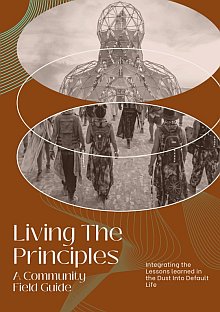
Ongoing learning on how to live as a community, respecting ourselves and everyone else while integrating with the greater whole.
Community living in the default world is about striking the delicate balance between personal agency and collective wellbeing. It is the understanding that true independence does not mean isolation, as mature, self-reliant individuals make for a mature, sturdy community. By taking responsibility for your own experience while simultaneously taking care of all you consider your community, you create an environment where everyone can thrive. This is the active practice of “respect yourself and respect everyone else.”
- Practise the 5-second scan before leaving a room: Pause for five seconds before exiting any shared space, like a lounge, bathroom, or workshop, to look back and reset the area to neutral, ensuring you don’t leave a mess for the next person.
- Use the “Scrape, Rinse, Stack” protocol in shared kitchens: When you are done eating, immediately scrape food scraps into a compost bin, rinse your dishes so residue doesn’t harden, and stack them neatly or place them in a dishwasher so the sink remains usable for others.
- Manage your pets and follow the “Leave It Better” poop rule: Keep your animals under voice control or on a leash in communal zones, clean up their messes immediately, and take community care a step further by picking up pet messes that aren’t even yours.
- Respect shared spaces and time: Practise everyday consideration by cleaning up after yourself, keeping noise levels appropriate for the time of day, and valuing the time and energy of the people you live and interact with.
- Communicate needs proactively: Do not expect your community, family, lovers, friends, or housemates to read your mind. Express your boundaries, desires, and energy levels clearly and kindly in ways that are meaningful for you. If you physically lack the energy or “spoons” to clean or reset a space, actively communicate that and ask a friend for help.
- Practise rapid correction when you slip up: accept that you will sometimes be grumpy or leave a cup behind, but when you realise you have left a wake of chaos, immediately turn around, take ownership of it, and tidy it up.
- Practise active empathy: Check in on your neighbours and friends regularly, showing genuine care by offering a listening ear, sharing a meal, or lending a hand with groceries.
- Maintain personal agency: Integrating into a community does not mean losing your individuality. Hold onto your self-respect and do not compromise your core values just to fit in. At the same time, make it easy for other members of your community to embrace their own individuality and agency, without needing to compromise themselves in order to fit in.
Community living is not about erasing the self; it's about expanding it. When you recognise that your own wellbeing is intimately tied to the wellbeing of those around you, acts of consideration stop feeling like obligations and start feeling like natural extensions of self-care.
Allow yourself and others to embrace and demonstrate all your unique gifts and individual personality, through creative and authentic expression.
Whether navigating the bustling streets of Sandton or retreating to the Karoo, this principle demands authenticity over conformity. It means safely pushing the boundaries of default-world norms so that you can demonstrate more of your divine uniqueness while also encouraging society to slowly expand its tolerance for diverse uniqueness.
- Wear what makes you shine: From double-breasted suits to colourful summer dresses, allow your clothing and accessories to be a genuine extension of your joy, regardless of social norms.
- Express yourself in everyday actions: Recognise that self-expression goes far beyond your wardrobe; it includes your hairstyles, body art, the music you play, how you walk, dance, or move, and even the unique way you perform your job.
- Add an unconventional, creative element to your daily attire: Push the boundaries of standard dress codes gently by incorporating something uniquely “you” into your outfit, such as a tie-dyed scarf, mismatched socks, or colourful underwear.
- Engage in continuous creative play: Encourage your inner child by exploring hobbies simply for the exuberance of doing something imperfectly, whether that means joining a dance or expressive movement class, building art, or creating your own clothing, jewellery, and furniture.
- Communicate your boundaries clearly: Practise expressing your authentic feelings verbally or non-verbally by using “I” statements, and do so assertively without apologising for your needs.
- Embrace body positivity and naturism: Actively work to overcome the shame taught by society by normalising the human body and embracing your natural form in appropriate, safe, and consenting environments.
Remember the “Boiling Frog” analogy for societal change: by consistently and safely expressing your quirks, you make them the norm, forcing the default world to adjust its rigid boundaries.
Our community encourages the individual to discover, exercise and rely on their inner resources, including intuition and innate abilities, while developing and improving on crucial life skills.
This principle is the bedrock of personal sovereignty. It requires taking 100% responsibility for your emotional state, physical preparedness, and life direction. However, remember that no human is an island; true self-reliance includes knowing when and how to source knowledge from others to augment and improve on your own capabilities.
- Trust your internal compass through somatic check-ins. Pay attention to your body’s physical sensations to identify an expansive “yes” or a contracting “no", relying on this internal guidance system to navigate your boundaries and ventures.
- Make your wellbeing a priority. Take personal responsibility for your emotional baseline by establishing accessible, daily practices such as meditation, movement, or appreciation.
- Maintain emergency resources: Keep a simple survival pack with 5 to 10 litres of water, first-aid, repair kits, and rations or long-shelf-life food. Include in your pack weather-proof guide cards, books, and other knowledge bases on survival, food growing and accumulation, accommodation, etc. so that you can be a stable anchor during a crisis rather than becoming a liability to others.
- Continuously upskill: Regularly educate yourself to expand your self-sufficiency in various everyday areas, including online search techniques, homemaking, dressmaking, and navigating interpersonal relationships.
- Use Internet tutorials while we have Internet to learn how to fix or build things yourself. Take the initiative to learn new skills such as tiling a floor, fixing a geyser, or cooking a meal rather than immediately paying someone else or relying on technology to do it for you.
- Learn from the collective: Bolster your own capabilities by actively engaging with experienced community members to share skills, acquire apprenticeships, and seek out mentorships.
Identify where you feel a “yes” in your body. Is it expansive and warm? Where do you feel a “no"? True self-reliance begins with trusting this internal compass. As you improve your knowledge, skills, and grow in experience and wisdom, this somatic guide also expands and becomes a more effective and reliable system.
As a community, we rely on the sharing of knowledge. We encourage the passing on of skills, experience, and wisdom to empower others.
This principle rejects the factory-like institutions of default-world education. It frames learning as a lifelong, joyful lifestyle where every member is simultaneously a student and a teacher throughout their lives.
- Compassionately educate others instead of judging their mistakes: When someone does something harmful, like littering or disrespecting a shared space, take a deep breath and gently explain the impact of their actions to help them understand, rather than getting angry or acting self-righteous.
- Share the Soft Skills: Actively teach the humanity curriculum of communicating boundaries, conflict navigation, and emotional hygiene in your daily life to ensure that the people around you can evolve together.
- Support neuro-inclusive learning: When explaining concepts or teaching others, cater to different mentalities by using project-based learning and hands-on apprenticeships rather than relying on rigid, sit-down lectures.
- Mentor newcomers: Take on a guiding role to act as a sponsor or mentor for individuals who are navigating the transition from the default world into conscious community living, or simply helping them adjust to new environments.
- Host skill-sharing workshops: Take the initiative to organise and formally teach others what you know, whether that involves practical skills like knot-tying, coding, and massage therapy, or interpersonal skills like non-violent communication.
Growth does not stop at 18. True education includes the unlearning phase; actively de-conditioning scarcity mindsets and transactional behaviours inherited from the default world.
Anyone may be a part of the community. We welcome and respect the stranger. No prerequisites exist for participation in our community.
Radical inclusion is unconditional. In the default world, it is the active dismantling of barriers that prevent certain people from inclusion for no sane reason. It means shifting from mere tolerance to enthusiastic acceptance, ensuring spaces are safe for all intersections of humanity, celebrating queer, trans, and neurodiverse individuals without applying heteronormative or neurotypical expectations.
- Practise everyday inclusion in simple interactions: Make active choices to be welcoming in your daily life, such as exercising patience and giving way in traffic, or inviting a stranger who is sitting alone to join your table or conversation. Show consideration to people and treat them like their existence matters. Treat everyone you encounter — even frustrating drivers in peak hour traffic — like members of your extended family, offering them connection and unconditional acceptance.
- Support the quiet ones: Recognise that not everyone experiences inclusion the same way. For introverts, shy individuals, or those living with social anxiety, for example, a loud, high-energy welcome can feel as excluding as being ignored. Create low-pressure “opt-in” entry points into your social spaces where people can simply exist alongside others without the pressure to perform or converse; A quiet corner, a tangible background task to contribute to rather than a conversation to perform (such as tending a fire, chopping vegetables, or managing a music playlist), or a simple one-on-one check-in before a group gathering. Inclusion is not just about opening the door; it is about making sure the room itself feels safe to enter, and allowing all people to feel like a valuable part of the collective energy without being the centre of attention.
- Normalise the sharing of pronouns and respect diverse orientations: Shift from mere tolerance to enthusiastic acceptance by openly sharing pronouns and respecting diverse gender identities and presentations. Extend this acceptance to diverse relationship structures, such as polyamory or relationship anarchy, entirely without judgement.
- Practise cultural curiosity: Actively seek to understand the norms, values, and expressions of cultures different from your own in a respectful, non-appropriative way; not as novelties to consume, but as living frameworks worthy of genuine respect. Share your own cultural practices openly and invite reciprocal exchange, whether through shared meals, storytelling, music, ritual, or other communal gatherings. By actively listening, asking questions, and participating in these shared norms, we transform inclusion from a passive policy into a vibrant celebration of the diverse tapestry that makes up our community. When cultural norms conflict, lead with curiosity rather than judgement, and be willing to examine which of your own norms and defaults are cultural rather than universal. The goal is not the erasure of difference, but a community fluent in many ways of being human.
- Include children honestly in discussions: Avoid creating unnecessary divisions by telling children they are “too young” to know something; if they take the initiative to ask for information, include them in the discussion in an honest and responsible manner.
- Champion orientation and perceptual inclusion: Proactively create environments that cater to differently oriented individuals, which can be as simple as ensuring tools are available for left-handed people or offering information for those who favour audio perception over visual perception.
- Advocate for physical accessibility: Use your voice to push for inclusion in accommodations, workspaces, and commercial areas so they are safe and accessible for differently bodied people (e.g., shorter, taller, or heavier individuals) and differently abled people.
- Offer restorative inclusion to those who cause harm: Recognise that no human is static and move away from punitive “us and them” exile systems; if someone commits an offence or causes harm, true radical inclusion means offering them a mediated, restorative space to acknowledge the harm, foster empathy, and actively reform.
Inclusion is an ongoing practice of noticing who is absent from the room and asking why, dismantling our own unconscious biases while we do. The most radical act is often the simplest: making space, pulling up a chair, and meaning it. Every barrier we dismantle, whether in our homes, workplaces, or on our streets, sends a ripple that reshapes what community can look like. When we make consistent, deliberate effort to understand and welcome those who are different from us, we expand the richness of our collective human experience and build something genuinely resilient in the process.
The value of a gift is unconditional. Gifting is an act of pure loving consideration in which an enthusiastic giver genuinely shares their gift with an enthusiastic receiver, without contemplation of a return or an exchange for something of equal value.
Moving beyond a transactional mindset to a relational one. In the default world, this means sharing your skills, time, or resources simply because it brings you joy to do so, while ensuring you do not deplete your own energetic reserves while doing so.
- Practise small acts of invisible labour. Perform everyday tasks like scraping, rinsing, and stacking dishes in a shared sink so the next person has a clear space, which is a profound yet unseen act of radical gifting.
- Provide “fluffing” or emotional care. Offer simple, caring gestures like making a cup of tea or checking in on friends, which are vital and celebrated contributions to your community.
- Allow yourself to receive. Remember that a gifting economy requires receivers; allow others the joy of giving to you, and accept that some days you need to open up and receive rather than just being the giver.
- Practise energetic consent when giving. Ensure you only offer your time or resources from a place of expansive warmth and a “Hell Yes!”, rather than out of guilt, people-pleasing, or obligation, so that you do not deplete your own energetic reserves.
- Share your professional skills. Offer your expertise, such as web design, plumbing, or bodywork, through community networks or barter systems, separating your inherent worth from fiat currency and fostering a relational mindset over a transactional one.
- Budget your resources: Determine what you have an abundance of (like a talent for giving massages) and give it freely without expecting anything in return, while always ensuring you ask first if your gift is actually wanted.
- Participate in a library economy: Share items like tools, camping gear, or even vehicles with your local community so that everyone has access to these resources without each person needing to own them individually.
Gifts are not given from obligation (those are transactions in disguise). The subtle art of radical gifting lies in first cultivating genuine abundance within yourself (of time, skill, attention, and/or resource) and then releasing part of that abundance without attachment to outcome. In fact, the most profound gifts often have no physical form; Giving your undivided attention, offering a safe space for someone to be vulnerable, or simply sharing a moment of silent appreciation can be the most radical acts of generosity in a highly distracted world. Notice, too, how fluently you receive yourself: the gifting economy is a full circle, and the person who cannot accept gracefully quietly closes one side of it (as one cannot give when nobody is willing or able to receive).
Our community values creative cooperation and collaboration. We strive to produce, promote and protect social networks, public spaces, works of art, and methods of communication.
Moving from “Me” to “We”. This principle replaces the feral, individualistic mindset of the default world with shared responsibility, operating under the ethos that when we take care of each other, we take care of the whole.
- Respect the invisible labour of others: Never leave a mess assuming that “the cleaners will get it”; instead, treat every shared space as your own and acknowledge the effort others put into maintaining the environments you use.
- Acknowledge your varying energy levels: If chronic pain, fatigue, or a lack of emotional “spoons” prevents you from contributing physically to a communal task, communicate your needs openly with your group or trusted people rather than simply withdrawing without communicating anything.
- Help others without expecting a direct reward: Actively look for ways to assist vulnerable people in your daily life to move away from an insular mindset and foster a closer, more connected society.
- Do not wait for someone else to solve a problem: When you notice an issue in your shared environment, step up and take the initiative to fix it yourself or work with others to create the change you want to see, rather than expecting someone else to handle it.
- Share the workload of menial tasks: Engage in collaborative co-operation by doing everyday tasks like sweeping or washing shared floors together, which helps to completely remove any sense of hierarchy or “us and them” mentalities.
- Collaborate in business and creative projects: Accept that we are all in this together and actively choose to co-operate and collaborate in your professional life, creative endeavours, and co-habitation arrangements. Collaboration over competition.
- Pool your diverse gifts and skills: Actively bring your unique talents, energy, and resources together with others to support the betterment of all individuals and the overall community, ensuring that everyone thrives through shared stewardship.
Communal effort is about proactively ensuring everyone feels seen, safe, and emotionally supported within a space, not just contributing physical labour.
Immediate experience of what is right now available is, in many ways, the most important touchstone of value in our culture. We seek to overcome barriers that stand between us and a recognition of our inner selves, the reality of those around us, participation in society, and contact with our natural world.
All our power resides in the present moment. Immediacy requires presence; stepping away from time-obsessed schedules to trust our intuition. It means being fully aware of personal boundaries and external reactions, and taking a moment to decide what you truly want to say “yes" to and what you want to say “no" to.
- Master technology instead of letting it master you: Use digital tools mindfully to enhance your current connections, rather than allowing your screens and devices to constantly pull your attention out of the physical room you are in. Mute your notifications or put your devices into flight mode, and limit distractions when you want to be more fully present in your environment.
- Practise mindful presence: Be fully present in your current moment so you can accurately assess situations as they happen, allowing you to immediately acknowledge and adjust if you accidentally overstep someone’s boundary or notice they are struggling to communicate one.
- Go with the flow in the finer details: While it is healthy to maintain your big-picture planning, practise allowing the finer details of an experience to unfold naturally without feeling a constant need to direct or micromanage every moment.
- Batch your energy output: Set specific boundaries for when people can access your time and energy, such as dedicating specific, limited hours (like 9 am to 11 am) to check and respond to emails, rather than multitasking constantly.
- De-escalate your schedule: Actively create open, unallocated space in your daily life to allow for leisurely engagement, spontaneous gatherings, and creative play, which grants you the freedom to live according to your own personal pace.
- Honour altered states and vulnerability: When someone around you is experiencing a deep emotional release or vulnerability, practise simply holding space for them in the present moment without trying to “fix” their problem or rush their healing process.
- Prioritise immediacy over tradition: Stop doing things just because “that is how it has always been done"; continuously evaluate your habits, practices, and community systems in the present moment to ensure they are still the most joyful, effective, and efficient choices.
Immediacy is the antidote to anxiety. By focusing entirely on what is directly in front of you — the person, the task, the breath — you disconnect from the fears of the future and ground yourself in deep, consensual connection.
In order to preserve the spirit of gifting, our community seeks to create social environments that are unmediated by commercial sponsorships, transactions, or advertising.
In our daily lives, this translates to conscious commerce. It is the practice of placing higher value on human connection and creative expression than on monetary exchange, corporate productivity, or the relentless pursuit of accumulating the dollar dollar.
- Protect your attention: Actively curate your digital and physical environments to limit your exposure to advertising, targeted algorithms, and consumerist programming.
- Focus on “being” over “doing”: Reject the default-world notion that your productivity, success, and self-worth are solely measured by your commercial output or financial wealth.
- Vote with your wallet: Be vigilant about how unscrupulous companies try to manipulate you, and consciously choose to spend your money only on businesses and products that deserve it and align with your personal values.
- Value the intangible: Treat a shared home-cooked meal, a crafted gift, a helping hand, or a creative performance as equal, if not superior, in value to a paid service.
- Decommodify your advice: Avoid the “saviour complex” by asking people if they are looking for comfort or if they are looking for solutions before offering to fix their problems, ensuring your input is actually wanted rather than pushing unsolicited “value”.
- Engage in alternative exchange: Trade your time, companionship, and services with your peers through bartering or non-monetary trade, such as swapping a web design skill for a massage, or a cooked meal for a permaculture lesson, relying less on cash transactions wherever possible.
- Practise conscious commerce in business: If you are a business owner, treat your customers fairly and like humans, actively observing principles of inclusion, community, and gifting within your company rather than solely focusing on a transactional bottom line.
Every transaction carries an energetic cost beyond the financial one. When you begin trading time for time, skill for skill, and presence for presence, you start to notice how richly your life is already stocked, and how little of what advertising sells you was ever actually missing. The quietest rebellion available to any of us is simply to need less of what is for sale. You also radically reclaim your inherent worth when you stop equating your value with your productivity or your purchasing power. Free yourself to experience life purely for the joy of existing, creating, and connecting.
Our community is committed to a radically participatory ethic. We believe that transformative change, whether in the individual or in society, can occur only through the medium of deeply involved personal participation.
We expand our being through doing. Participation means actively taking ownership of your experience rather than passively consuming what others have built and contributed. Everyone is a co-creator, with the potential to move at any time from a passive observer to an active contributor.
- Show up fully in your everyday life: Whether you are attending a workshop, building a project, or joining a party, make the choice to bring your authentic, engaged energy to the space instead of passively standing on the sidelines.
- Focus your participation on uplifting others: Recognise that arguing and complaining without offering any solution is a detrimental form of participation. Instead, shine your light by brainstorming ways to meaningfully contribute to your workplace or neighbourhood, choosing to do and contribute more where possible.
- Defy stagnant living by building your own culture: Instead of passively consuming what others have built, participate heavily in activities like homesteading, crafting, and media creation so that you are actively building the culture you want to consume.
- Turn off your streaming services and create your own experiences: Stop only living vicariously through characters or social media influencers; instead, spend more of your time creating your own art, writing, or going on your own adventures.
- Embrace a “Do-ocracy” mindset: If you see a problem or have a new idea, take the initiative to solve the issue or build the project yourself rather than waiting around for someone else’s approval to begin. You may also have to form the committee and taskforce that manages the project.
- Transition from a participant to a contributor: Move beyond simply attending events or consuming experiences by dedicating your time to the operational needs of your local community, which can take the form of volunteering for gardening, logistics, or creative enrichment.
In a Do-ocracy, power dynamics dissolve. The people who do the work are the ones who make the relevant decisions, naturally weeding out bureaucratic stagnation and empowering those who show up.
We value civil society. Community members who organise events should assume responsibility for public welfare and endeavour to communicate civic responsibilities to participants.
The “default world” isn’t a fixed reality we have to endure; it is simply a set of agreements we can choose to rewrite. True civic responsibility evolves one from being a passive consumer of society to an active producer of it, requiring us to actively build the society we want to live in. The world changes when we change it. This means holding ourselves and each other to a high standard of kindness, volunteering our time, and establishing robust cultures of consent and communication. A neighbourhood where people greet each other becomes a neighbourhood where people notice when someone is missing. A workplace where feedback is given kindly becomes one where problems are surfaced before they fester. Start small. Stay consistent. The ripple is larger than it looks.
- Start taking responsibility in your own household: Before taking on larger neighbourhood issues, begin your civic duty by addressing problems, making improvements, and taking active responsibility within your immediate home and family environment.
- Establish a culture of consent in daily life: Actively build a safe society by understanding and practising consent as an ongoing, voluntary, informed, and enthusiastic agreement that can be revoked at any time.
- Utilise the “Clean Air Protocol” to manage disputes: Address interpersonal friction early by requesting clearing conversations, owning your own triggers, and seeking a creative synthesis rather than letting resentments fester.
- Apply “Do-ocracy” to your suburb: Take active ownership of the things you complain about in your local area; for example, if a park is littered, organise a cleanup yourself instead of waiting for the municipality to do it.
- Volunteer and give back to the vulnerable: Dedicate a portion of your personal time to community service, local outreach programs, or assisting those who are vulnerable in your society.
- Collaborate with established local entities to enact larger changes: Instead of trying to solve systemic issues as a solo vigilante, work together with peers, local police, and security companies to build structured initiatives like a neighbourhood watch or community awareness classes.
- The “Maybe” Negotiation: Practise pausing, asking for time, and sitting in the discomfort of not having an immediate answer when your boundaries are tested, thus taking responsible ownership of your civic interactions.
An empowered community recognises that we are the institution, and the health of the community is a reflection of the private choices its members make when no one is watching, whether to pick up the litter they didn’t drop, to speak up for people who aren’t there, or to extend patience to someone who has not yet earned it. Civic responsibility asks that we stop waiting for permission to care. In a culture that has largely outsourced community wellbeing to institutions, bureaucracies, and algorithms, the act of showing up is itself a form of resistance. Civic responsibility can also be the antidote to modern isolation. When we step up to take ownership of our shared environments, we break down the walls of hyper-individualism. The society we want does not exist somewhere ahead of us waiting to be found; it is assembled, piece by piece, in the daily choices of people who decided not to look away.
Our community respects the environment. We are committed to leaving no physical trace of our activities wherever we gather. We clean up after ourselves and endeavour, whenever possible, to leave such places in a better state than when we found them.
We elevate “Leave No Trace” to “Leave It Better”. This extends beyond picking up litter; it is an active commitment to ethically improving every physical space and every human life we interact with.
- Smile at people you pass or pick up neighbourhood trash. Instead of just avoiding making a mess, actively improve the environments and lives you touch, which can be as simple as picking up litter or brightening your workplace with a smile.
- Practise the “Leave it Better” mindset in minor actions. Consider the next person in simple daily activities, from how you park your bicycle to how you leave a used teacup, by treating the shared environment as a direct extension of your own energy field.
- Practise emotional “Leave It Better”. Ensure that your everyday interactions, feedback, and overall presence leave the people you encounter feeling uplifted and more confident than they were before you arrived.
- Minimise waste at the source. Make a proactive habit of repackaging supplies before travelling to reduce potential trash, and separate your organic waste for composting or bokashi buckets.
- Upcycle and repair: Instead of automatically throwing away broken items, take the time to mend them or repurpose the materials, actively keeping waste out of local landfills.
- Implement permaculture principles at home. Invest in improving your household’s environmental impact by utilising grey-water recycling, rainwater harvesting, and passive solar design where possible.
- Create a larger ethical initiative. Take the principle to a structural level by building a project that actively betters society, such as creating a company that performs legal dumpster dives to run a soup kitchen for the underprivileged, or establishing a “ghost kitchen” to upcycle waste food into nutritious meals.
Our environment is an extension of our energy field. Leaving a space beautiful is a direct investment in the mental health of whoever occupies it next.
At its core, consent is the voluntary, informed, and enthusiastic agreement to participate in any activity or share information, given entirely without coercion or manipulation. It is about respecting others’ autonomy, ensuring everyone feels safe and valued, and comfortable with how personal boundary space is being managed.
In the default world, consent is often reduced to avoiding lawsuits or basic HR compliance. Adapting true consent means actively building high-trust environments by addressing the invisible boundaries of the modern age: power dynamics (acknowledging how positional power naturally warps consent), cultural translations (moving beyond individualistic frameworks to navigate how respect and assertiveness look across different global cultures), and digital sovereignty (recognising modern digital boundaries, including expectations around text response times, the right to disconnect after hours, and the permanence of tagging or sharing screenshots).
- Practise Everyday Consent: Explicitly ask for permission before entering someone’s personal space, giving a hug, taking a photo, borrowing an item, or sharing someone’s contact information with a third party.
- Shift to “Active Comprehension”: Make space for neurodivergent processing styles in conversations or meetings by understanding that forced eye contact can be uncomfortable, and that doodling or looking away does not mean someone isn’t listening intently.
- The Consent of “Helping”: Avoid the “Saviour Complex” by asking for permission before unloading unsolicited advice or attempting to fix a problem. Practise asking: “Are you looking for comfort, or are you looking for solutions?”
- The Consent of Feedback: Ask for permission before giving constructive criticism in the workplace or personal relationships (e.g., “Are you in a headspace to receive some feedback on that project?”
- Communicate with “I” Statements: Express your feelings and boundaries clearly and assertively without placing blame, such as saying “I feel anxious because I value order” instead of “You are being messy”.
- Recognise the Energetics of Consent: Tune into your somatic, physical sensations to locate your true boundaries. Learn to feel the difference between an enthusiastic “Hell Yes!” (which feels expansive, warm, or tingly) and a reluctant, people-pleasing “Yes” (which feels like a contraction, a knot in the stomach, or dread). Understand also the distinction between transactional consent (agreeing out of obligation or a sense of debt) and relational consent (driven by genuine, authentic desire).
- Understand power dynamics and survival compliance: Differences in age, wealth, community status, or professional roles naturally warp consent. The presence of authority can trigger trauma responses such as “fawning”, where a person’s nervous system overrides their internal “no”. Because of this, the burden of ensuring true consent shifts heavily to the person holding the power; it is their active responsibility to dismantle hierarchies where possible, check in regularly, and remain vigilant in identifying compliance hiding as genuine consent.
- Honour digital boundaries: Always ask for permission before taking photos, sharing screens, forwarding private texts, or tagging people online. Respect people’s right to disconnect and never expect replies to work messages at times that weren’t explicitly agreed upon. In intimate partnerships, establish clear mutual agreements regarding digital privacy, shared accounts, and location tracking.
- Practise Restorative Accountability: When someone oversteps a boundary, address the specific behaviour and not their character. Initiate a “Clear Air” conversation using “I” statements and Sovereign Speech. Model a Sovereign Apology that centres the affected person’s experience. Collaboratively determine a path to repair. And define your own “unreformable threat” boundaries. A person who repeatedly refuses to engage in restoration has crossed a line that warrants clear consequences, reduced contact, or full distance.
True consent is a living, ongoing conversation. The more fluent you become in reading your own body’s signals (that expansive warmth of a genuine yes, and quiet contraction of a reluctant no) the more honestly you can show up for others. Consent culture does not begin in grand dramatic moments; it begins in the ten thousand small daily interactions where you choose to ask instead of assume.
These principles are not rigid laws dictated from above; they are living, breathing frameworks designed to be challenged, interpreted, and woven into the unique fabric of your daily existence. The true magic of this culture is not found in the dust of a temporary city, but in how you carry that dust back into the default world.
You are empowered to adapt these guidelines to fit your reality. Discover your own ways of implementing radical inclusion at your workplace, experiment with decommodification in your relationships, and find your unique expression of communal effort in your neighbourhood. Take what resonates, experiment with what challenges you, and share your discoveries with the community.
- Experiment freely: Pick one principle each week and look for a single, concrete way to express it in your daily life, however small or imperfect the attempt.
- Share your discoveries: Tell your community what worked, what didn’t, and what surprised you. Your real-world experiments become part of the living curriculum for everyone around you.
- Embrace beautiful failure: Go out, make mistakes, learn from them, and resist the urge to perform perfection. The principles are a direction, not a destination.
- Carry the dust with you: Let the person you become at a burn or a free-minded gathering be the person you are on an ordinary Tuesday. That is the whole point; Practise being more of who you want to be until you are.
This is the beginning, not the end. Go out, make mistakes, learn, and above all, live your life with fierce intention and radical joy.